Integrating Faith
and the Academy
12:00 PM • Rosenwald Classroom
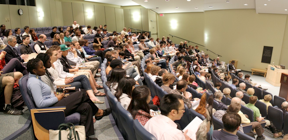
Faith once occupied a place of prominence in institutions of higher learning. Today, faith is often relegated to the private, personal sphere. Rarely do we approach scholarship from a viewpoint that welcomes and values faith-based perspectives. In this panel, prominent Dartmouth faculty will discuss their own experiences as Christian members of the secular academy, and explore a vision for integrating faith and reason to enhance scholarly inquiry.
Moderator
Lindsay Whaley, Ph.D.
Chair, Linguistics and Cognitive Science and
Associate Dean for Interdisciplinary Studies, Dartmouth College
Lindsay J. Whaley, Ph.D. joined the Dartmouth faculty in 1993. He is now Professor of Classics and Linguistics and serves as the Associate Dean for International and Interdisciplinary Studies. He graduated with honors from Calvin College, receiving a bachelor’s degree in linguistics, and religion and theology. He received an MA in linguistics in 1990 from State University of New York, Buffalo and continued his studies there receiving a Ph.D. in linguistics in 1993. Professor Whaley is an expert in the Tungusic languages of northern China and is known internationally for his work in language typology, which involves determining why some properties of language are common while others are rare. Over the last decade, Professor Whaley has become recognized for his research on language death and language revitalization.
Panelists
Bruce Huber, J.D., Ph.D.
Visiting Assistant Professor of Government, Dartmouth College
Bruce Huber is currently a visiting assistant professor in the Department of Government, Dartmouth College, and beginning this fall will be Associate Professor of Law at the Notre Dame Law School. After earning his BA at Stanford University and his JD at the University of California, Berkeley, he spent four years as the Minister to College Students at Menlo Park Presbyterian Church in Menlo Park, California. He recently completed his PhD in Political Science, also at UC Berkeley, and teaches and conducts research in the area of environmental law and politics.
-
M.Eric Johnson, Ph.D.
Benjamin Ames Kimball Professor of the Science of Administration Management, Tuck School
Director, The Center for Digital Strategies
M. Eric Johnson is Director of Tuck’s Glassmeyer/McNamee Center for Digital Strategies and the Benjamin Ames Kimball Professor of the Science of Administration Management at the Tuck School of Business. His teaching and research focuses on the impact of information technology on supply chain management. He has testified before the US Congress on information security and collaboration and published many related articles in the Wall Street Journal, Financial Times, Sloan Management Review, Harvard Business Review, and CIO Magazine. His research articles have appeared in numerous academic journals.
Before joining Tuck, Johnson taught at the Owen Graduate School of Management, Vanderbilt University. He was previously employed by Hewlett-Packard Co. and Systems Modeling Corp. Johnson is currently the president of the POMS College of Supply Chain Management and has served on numerous editorial boards. He holds a B.S. in Engineering, B.S. in Economics, an M.S. in Engineering and Operations Research from Penn State University, and a Ph.D. in Engineering from Stanford University.
Roberta Stewart, Ph.D.
Associate Professor of Classics, Dartmouth College
Roberta Stewart joined the Dartmouth faculty in 1990. She teaches in the Classics Department and Women and Gender Studies Program. Professor Stewart graduated with high distinction from the University of Michigan Ann Arbor with a B.A. in Latin, and received her Ph.D. in Classical Studies from Duke Univeristy in 1987. She has received numerous grants and awards: the Heinrich Schliemann fellowship at the American School of Classical Studies at Athens; a Fulbright Hayes grant for study in Italy; an NEH postdoctoral fellowship for Latin lexicography at the Bavarian Academy of Sciences in Munich; and an NEH grant for her current book project on Slavery and Slave Experience in Plautine Rome. Professor Stewart has published on problems in Roman history, Roman religion and Latin lexicography. Her first book considered the Roman use of sortilege (casting lots) in assigning public duty among elected officials. Her current project attempts a close historical analysis of Roman slavery, the institution and the experience, at a particular historical moment. She is looking forward to returning to work on Roman religion (the assassination of priests and the political significance of the emperor's priesthood). In her spare time, Professor Stewart is developing a program for reading Homer with combat veterans.