Integrating Faith
and the Academy
Stoneman Classroom
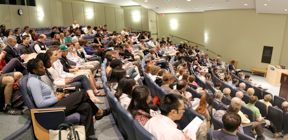
Faith once occupied a place of prominence in institutions of higher learning. Today faith struggles to maintain a place of respectability and relevance in the same institutions. The “fourth quadrant” stance of the Apologia and the Eleazar Wheelock Society rejects the secularizing of the academy, and seeks to explore the integration of academic rigor, reason, and faith. In this panel prominent and successful academicians will discuss the current state of the academic environment, and explore alternative perspectives which can make room for faith and reason to once again be truly integrated, each informing and enriching the other.
Moderator
Fr. Jon Kalisch
Chaplain, Aquinas House
Fr. Jonathan Kalisch is chaplain for Aquinas House, Dartmouth’s Catholic Student Center and Ministry. Fr. Jon attended Georgetown University, where he majored in American Studies with a concentration in history and government. After graduating in 1994, he worked for Price Waterhouse in Warsaw, Poland. He discerned a call to the priesthood while making a pilgrimage from Poland to the Holy Land. He returned to the United States, and joined the Dominican Order in 1996 after working as a political campaign manager. During his time in the seminary, Fr. Jon received a Masters of Divinity and a Licentiate of Sacred Theology. He was ordained a priest in 2003, and in 2004 was assigned as campus minister to Quinnipiac University, where he remained until he came to Dartmouth in the Fall of 2009.
Panelists
Jay E. Bruce, Ph.D. D’96
Professor of Philosophy, John Brown University
Jay E. Bruce, Ph.D., Dartmouth class of 1996, is an assistant professor of philosophy at John Brown University. Professor Bruce pursued a double major in engineering sciences and English at Dartmouth and then studied theology for three years at the University of Oxford. After working in London, first on the trading floor of an energy company and then for All Souls, Langham Place, Professor Bruce went to Baylor University to do his Ph.D. in philosophy. His dissertation, entitled Divine Choice and Natural Law investigates the relationship between God's choices and the moral order of things in the thought of Francis Turretin (1623-1687). He is currently revising this work for publication as a book.
Professor Bruce is married, and his wife is pregnant with their second child, a boy. He loves coffee, hates television, and walks to work.
Allen V. Koop, Ph.D. D’65
Professor of History, Dartmouth College
Allen V. Koop, Ph.D. is a professor of history at Dartmouth and has taught there since 1987. He received his bachelor’s degree from Dartmouth College in 1965 and his doctorate degree from the University of Pennsylvania. He teaches courses on the American Healthcare system, the History of Modern Europe from the Enlightenment through the Twentieth Century. Professor Koop is the author of several books including Stark Decency, the story of a World War II German POW camp in New Hampshire, where friendships among prisoners, guards, and villagers overcame the bitter divisions of war.
Edward M. Bradley, Ph.D.
Professor of Classics, Dartmouth College
Edward Mix Bradley, Ph.D. is an emeritus Professor of Classics at Dartmouth College. He received his B.A., M.A., and Ph.D. all from Yale University and taught at Yale for three years before coming to Dartmouth in 1963. Dr. Bradley retired from the Dartmouth’s Department of Classics in June 2006 after teaching for 43 years at the College. Although retired, he continues to teach an occasional course at the invitation of the Classics Department.
Dr. Bradley’s principal areas of research and publication were in Greek epic literature, specifically that of Homer and Hesiod. While at Dartmouth, he taught courses on introductory Greek and Latin, Greek lyric poetry, Homer, Virgil, Lucretius and Ovid in the original language, as well as the epic literature of Greece and Rome in translation. In 1971, Dr. Bradley established the Classics Department's Foreign Study Program in Rome, Italy. From that time on, he dedicated himself to the study of, and the instruction in, the history, archaeology, art, and architecture of Italy from the Iron Age in Latium to the 6th century A.D. in Ravenna. He also has a keen interest in early Christian art and architecture.
Dr. Bradley is also a co-founder of the Classical Association of New England (CANE) Summer Institute at Dartmouth.
Lindsay J. Whaley, Ph.D.
Chair, Linguistics and Cognitive Science and
Associate Dean for Interdisciplinary Studies, Dartmouth College
Lindsay J. Whaley, Ph.D. joined the Dartmouth faculty in 1993. He is now Professor of Classics and Linguistics and serves as the Associate Dean for International and Interdisciplinary Studies. He graduated with honors from Calvin College, receiving a bachelor’s degree in linguistics, and religion and theology. He received an MA in linguistics in 1990 from State University of New York, Buffalo and continued his studies there receiving a Ph.D. in linguistics in 1993. Professor Whaley is an expert in the Tungusic languages of northern China and is known internationally for his work in language typology, which involves determining why some properties of language are common while others are rare. Over the last decade, Professor Whaley has become recognized for his research on language death and language revitalization.