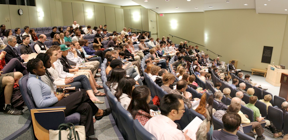
The Conflict of Science and Faith:
Is There One?
11:15 AM
Writing in 1609, Johannes Kepler – one of the first men to present scientific proofs for the Copernican cosmological model – exhorted the student of astronomy, "I urge my reader… Let him join with me in praising and celebrating the wisdom and greatness of the Creator, which I disclose to him from the deeper explanations of the form of the universe."1 The connection Kepler draws between praising God and explaining the universe, that is, between religious practice and scientific inquiry, seems out of place in our contemporary discourse. Indeed, modernity usually assumes an antagonistic relationship between the two. This supposed conflict of science and faith is actually a recent development. In this panel, we will examine the origins of this conflict, focusing in particular on the work of two 19th century historians John William Draper and Andrew Dickson White that gave rise to this myth, and will use this understanding of history to explore the intimate relationship of science and faith.
1Johannes Kepler, New Astronomy, Trans. William H. Donahue (Cambridge: Cambridge University Press, 1992) 65
Interviewer
Andrew Schuman D’10
Founding Editor-in-Chief, Dartmouth Apologia
Andrew Schuman graduated from Dartmouth College in 2010 with a double major in Engineering Sciences and Philosophy. He is the founding editor-in-chief of the Dartmouth Apologia, and serves as a founding director of the Eleazar Wheelock Society. He now directs the Waterman Institute, an independent initiative for faith and learning in the Dartmouth community, and is a pastoral intern at Christ Redeemer Church in Hanover. He is also a co-founder of the Augustine Collective, a national network of Christian journals on college campuses.
Guest
Lawrence M. Principe, PhD
Drew Professor of the Humanities, Johns Hopkins University
Lawrence M. Principe is the Drew Professor of the Humanities at Johns Hopkins University in the Department of the History of Science and Technology and the Department of Chemistry. His research focuses on the early modern period (1450-1750), especially in regard to chemistry and alchemy, and the interaction of science and religion. His recent publications include The Scientific Revolution: A Very Short Introduction (Oxford, 2011) and The Secrets of Alchemy (Chicago, 2012), both written for a wide audience. In 2005 he produced the DVD course “Science and Religion” for The Teaching Company. He is also the inaugural recipient of the Francis Bacon Medal for significant contributions to the history of science.